Count the insects: free printable counting worksheet
कीड़े · कीड़ों को गिनें
- Age
- 3–6
- Pages
- 1
- Paper
- A4
- Language
- हिं + En
No sign-up, no email. Print on plain A4 paper.
About this sheet
What is on the page, and how to get the most out of it.
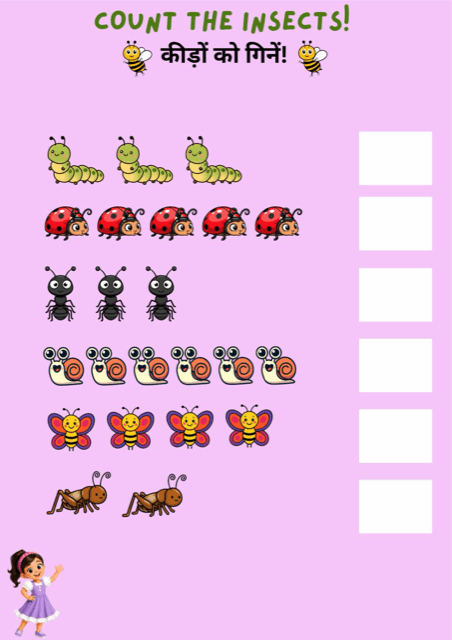
Six rows of insects: caterpillars, ladybirds, ants, snails, butterflies and a second row of ants, each with a box for the number.
Two rows of ants appear on the same sheet, drawn slightly differently. That repetition is the reason to use this page. A child working quickly will reach the second ant row, recognise it as one they have already done, and either skip it or copy the earlier answer.
Catching that is more useful than the counting itself. It is the difference between reading a page and assuming a page, and the assuming habit is worth interrupting early, well before it turns up in school work.
The insects are also small and closely spaced, which makes them harder to separate visually than the fruit or the animals. Expect this sheet to take longer than its six rows suggest.
What your child practises
Two similar ant rows make this as much about looking carefully as about counting.
- Telling apart two similar rows
- Counting small, closely spaced items
- Checking rather than assuming an answer
- Insect names in Hindi and English
Common questions
Why are there two rows of ants?
To catch the habit of assuming. A child working fast will recognise the second row and copy the first answer instead of counting it, which is worth noticing.
This sheet takes longer than the others. Is that normal?
Yes. The insects are small and closely spaced, so separating them by eye is harder than on the fruit or animal sheets even though there are fewer rows.