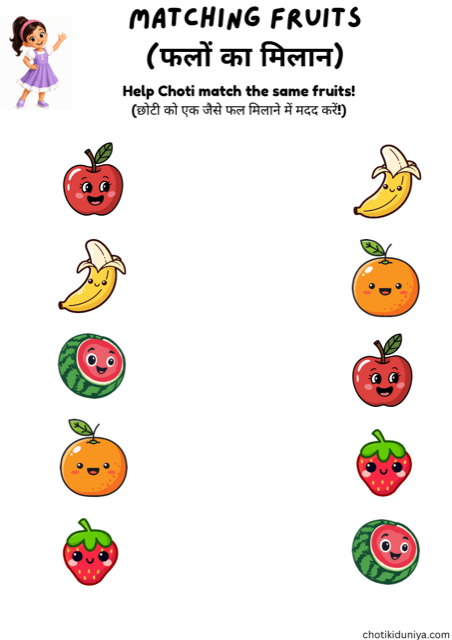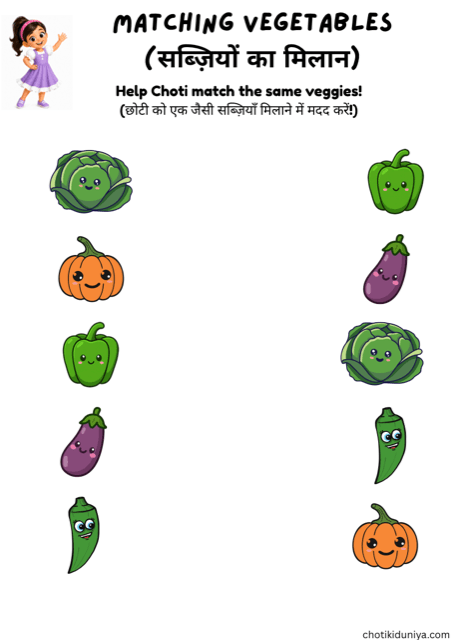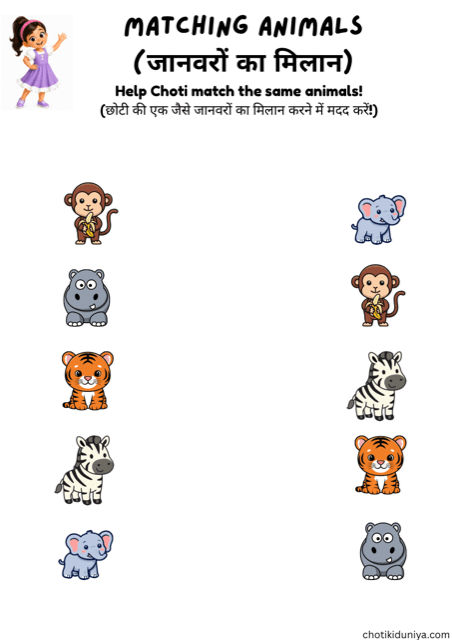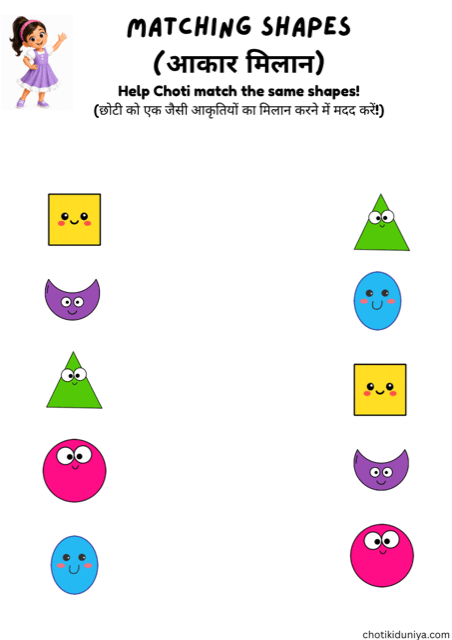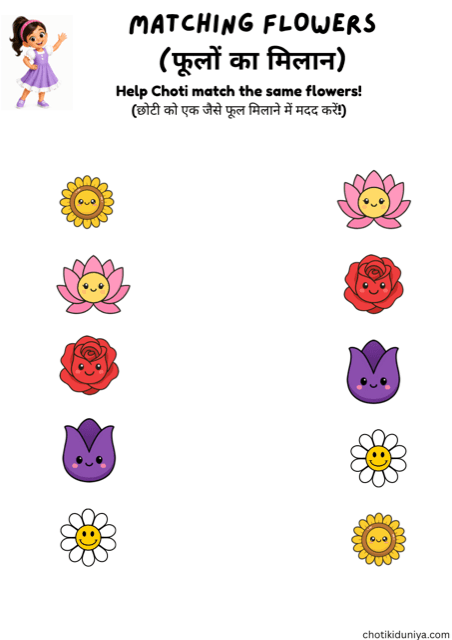
Match the flowers: free printable matching worksheet
फूलों का मिलान · छोटी को एक जैसे फूल मिलाने में मदद करें!
- Age
- 3–6
- Pages
- 1
- Paper
- A4
- Language
- हिं + En
No sign-up, no email. Print on plain A4 paper.
About this sheet
What is on the page, and how to get the most out of it.
Two scrambled columns of five flowers: sunflower, lotus, rose, tulip and daisy, to be joined in pairs.
This is the hardest sheet in the matching set. Every flower is roughly the same size, all of them are round arrangements of petals, and the differences come down to petal shape and count rather than anything obvious.
The daisy and the sunflower are the pair that catches children out. Both have a ring of narrow petals around a yellow centre, and telling them apart means noticing petal colour rather than overall form. Expect this one to take longer than the fruits and vegetables together.
It is worth doing anyway. Discriminating between two similar shapes is exactly the skill that will later separate a b from a d, or a 6 from a 9, and practising it on flowers carries none of the pressure that practising it on letters does.
The lotus is a good inclusion. It is the flower Indian children see in stories, on temple walls and on currency long before they see it in a book.
What your child practises
Five similar round flowers with only small differences, which makes this the hardest sheet here.
- Telling apart two very similar shapes
- Noticing petal shape and colour
- Persisting with a harder task
- Flower names in Hindi and English
Common questions
Why do children find the flowers hardest?
All five are round arrangements of petals at a similar size, so the differences are small. The daisy and sunflower in particular both have narrow petals around a yellow centre.
How does this help with reading later?
Telling two similar shapes apart is the same skill that separates a b from a d or a 6 from a 9, and practising it on flowers carries none of the pressure letters do.