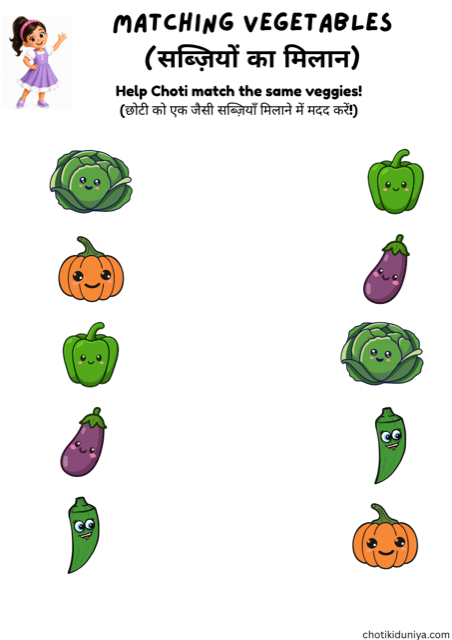
Match the vegetables: free printable matching worksheet
सब्ज़ियों का मिलान · छोटी को एक जैसी सब्ज़ियाँ मिलाने में मदद करें!
- Age
- 3–6
- Pages
- 1
- Paper
- A4
- Language
- हिं + En
No sign-up, no email. Print on plain A4 paper.
About this sheet
What is on the page, and how to get the most out of it.
Two scrambled columns of five vegetables: cabbage, pumpkin, capsicum, brinjal and chilli, to be joined in pairs.
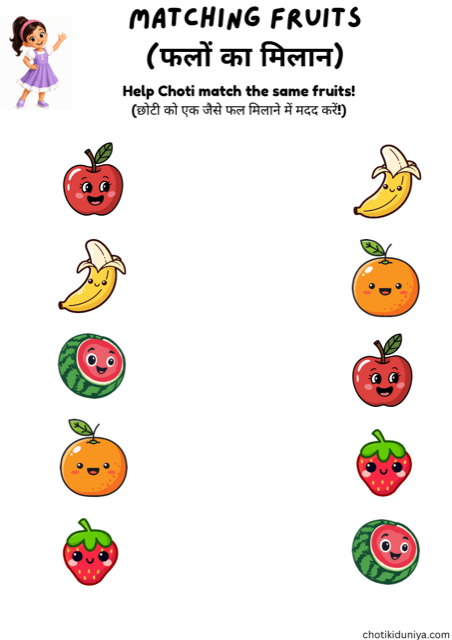
This is a step up from the fruit sheet for a reason that is easy to miss. Three of these five are green. Cabbage, capsicum and chilli all share a colour, so a child who has been matching by colour alone will suddenly find that it no longer works and has to start looking at shape instead.
That moment is genuinely useful. Watch whether your child slows down when they reach the green ones. Slowing down means they have noticed colour is not enough, which is a real shift in how carefully they are looking.
The vegetables are also worth naming as you go. Brinjal, capsicum and cabbage are words many children recognise on a plate long before they can name them, and the sheet gives a reason to say them out loud in both languages.
What your child practises
Three green vegetables mean colour alone stops working, which forces a closer look.
- Matching by shape when colour repeats
- Slowing down on a harder pair
- Comparing two similar items carefully
- Vegetable names in Hindi and English
Common questions
Why is this harder than the fruit sheet?
Three of the five vegetables are green, so a child matching on colour alone has to start looking at shape instead. That shift is the point of the sheet.
My child hesitates on the green ones.
That is a good sign. Hesitating means they have noticed colour is no longer enough to tell the items apart.