Peaks and coils: free printable line tracing worksheet
रेखाएँ ट्रेस करें · छोटी को रेखाएँ ट्रेस करने में मदद करें
- Age
- 3–5
- Pages
- 1
- Paper
- A4
- Language
- हिं + En
No sign-up, no email. Print on plain A4 paper.
About this sheet
What is on the page, and how to get the most out of it.
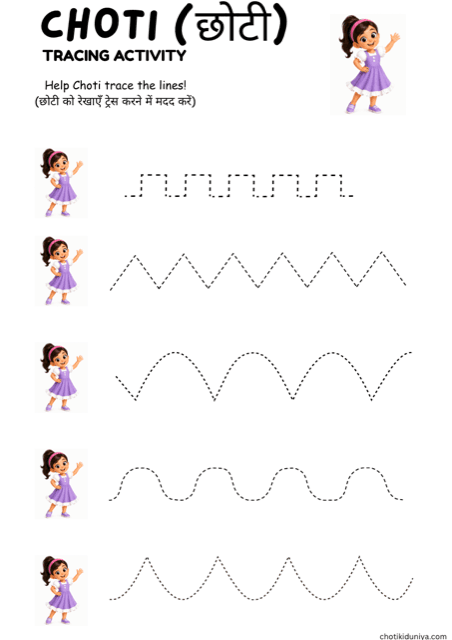
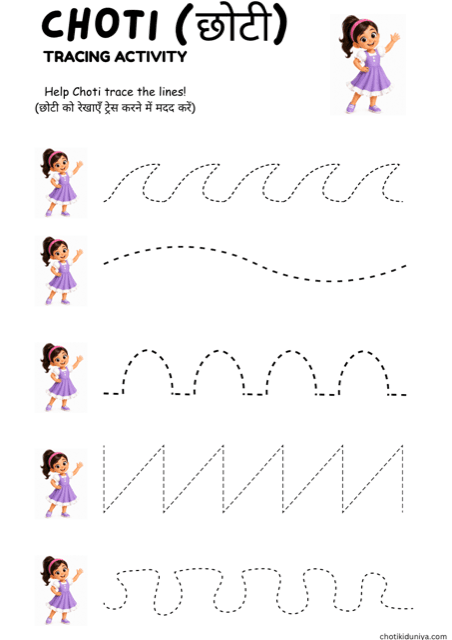
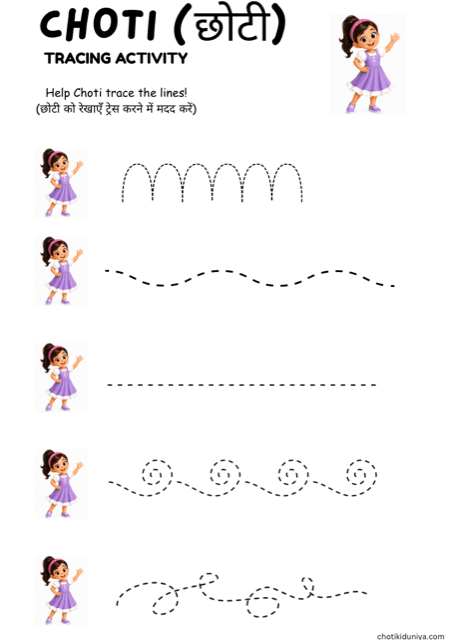
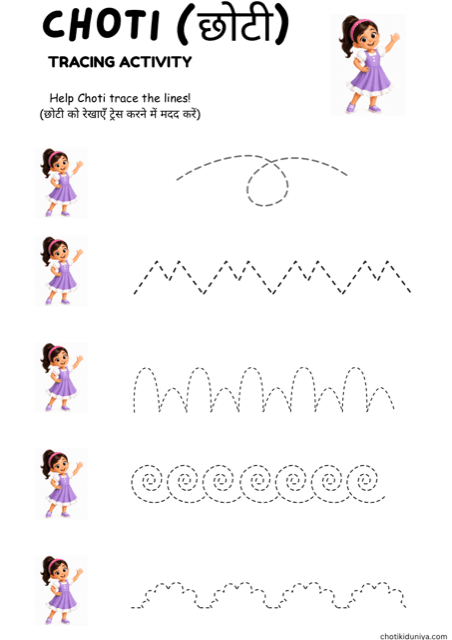
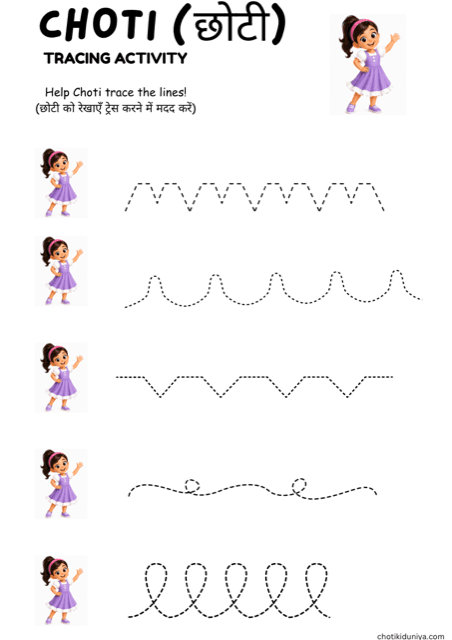
Five rows: tightly packed peaks, rounded arches, a wider zigzag, a straight line broken by two small loops, and a row of tall leaning coils.
The bottom row is the most advanced thing in the whole pre-writing set. Those tall coils lean slightly and connect to each other, which is what continuous cursive writing actually looks like. A child who can trace that row has the underlying movement for joined-up writing years before they will be asked for it.
The fourth row is quietly clever. It is a mostly straight line interrupted by two small loops, which means the hand has to change from a steady horizontal movement into a curl and back again without stopping. Switching between two movements mid-stroke is harder than doing either one repeatedly.
Do not expect the bottom row early. It is reasonable for a four year old to manage the top three rows and leave the last one alone for a year.
What your child practises
The most advanced sheet here, ending with the continuous coils that cursive is built from.
- Switching between straight and curling movements
- Tracing tightly spaced repeated peaks
- Producing connected leaning loops
- Preparing for joined-up writing
Common questions
My child manages the top rows but not the bottom one.
That is entirely reasonable. The tall connected coils are the most advanced thing in the pre-writing set, and leaving that row for a year is fine.
What is the row with loops in a straight line for?
It forces the hand to switch from a steady horizontal movement into a curl and back without stopping, which is harder than repeating either movement on its own.