Trace and color the letter M: free printable worksheet
रेखा बनाओ और रंग भरो
- Age
- 3–6
- Pages
- 1
- Paper
- A4
- Language
- हिं + En
No sign-up, no email. Print on plain A4 paper.
About this sheet
What is on the page, and how to get the most out of it.
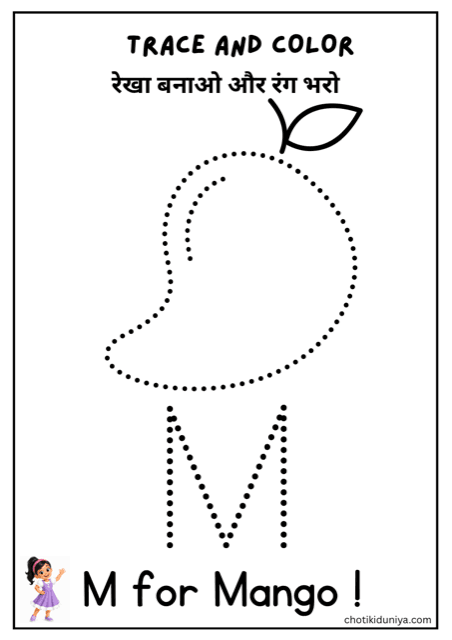
A dotted mango with a leaf to trace and colour, a dotted uppercase M below it, and the line M for Mango.
An M has four strokes: down, up-diagonal, down-diagonal, down. More movements than any other letter in this group, and the two diagonals in the middle have to meet at a point that sits between the two outer verticals.
The usual results are a middle V that does not reach far enough down, so the letter looks like two humps, or a letter that spreads too wide. Both are ordinary and neither is worth correcting hard.
M is also the other half of a confusion worth knowing about. An M turned upside down is a W, and children who have learned both often produce one for the other. Doing them well apart in time helps.
The mango deserves a mention. Most alphabet sets reach for a monkey or a mouse, and a mango is the fruit an Indian child actually knows by sight, taste and name in both languages.
What your child practises
Four strokes including two diagonals meeting in the middle, the most movements of any letter here.
- Sequencing four strokes in one letter
- Bringing a middle point down far enough
- Telling M apart from W
- Linking the letter M to the sound in mango
Common questions
My child writes M as two humps.
The middle point is not coming down far enough between the two verticals. Tracing slowly over the dotted guide and stopping at the bottom of the V usually sorts it.
My child confuses M and W.
A W is an M upside down, so this is common. Practising the two well apart in time works better than teaching them together.