Trace the number 6: free printable tracing worksheet
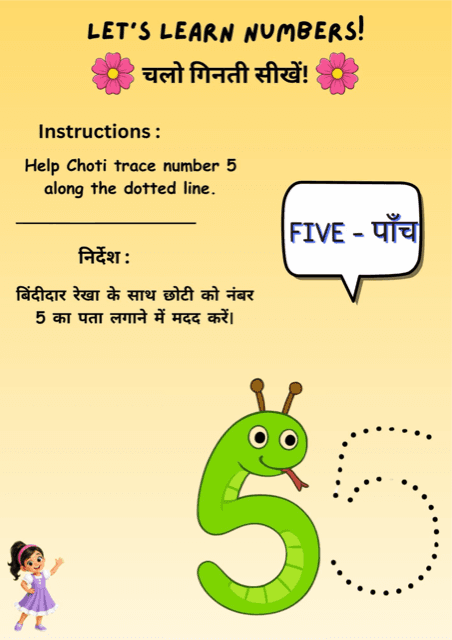
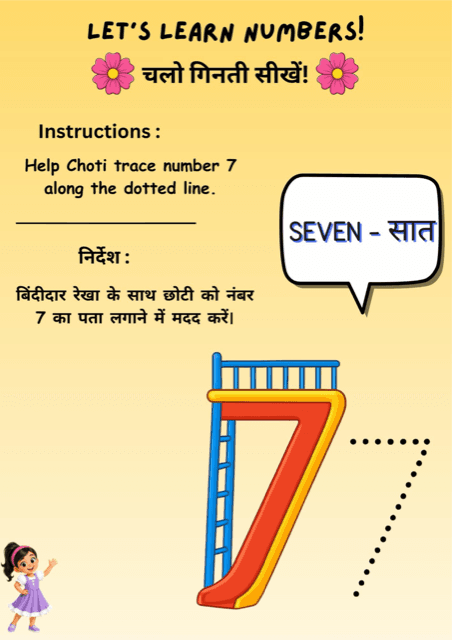
छः · चलो गिनती सीखें!
- Age
- 3–6
- Pages
- 1
- Paper
- A4
- Language
- हिं + En
No sign-up, no email. Print on plain A4 paper.
About this sheet
What is on the page, and how to get the most out of it.
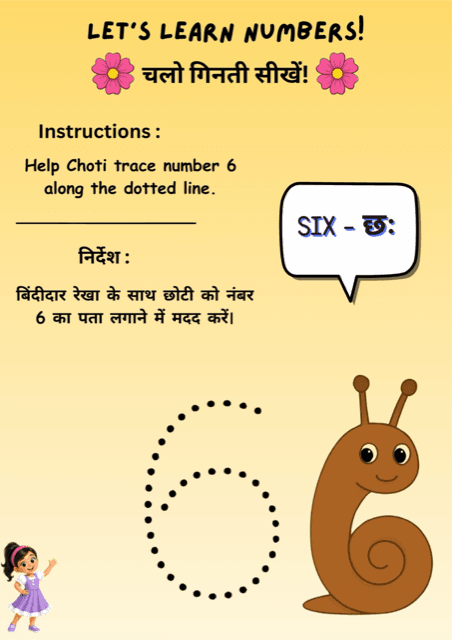
The number 6 drawn as a snail, its spiral shell forming the loop at the bottom of the digit, with a dotted 6 alongside.
A 6 is one continuous stroke that curves down from the top and then closes into a loop turning anticlockwise. No pencil lift, no corner, just a long controlled curve that has to finish by meeting itself.
Closing a loop back onto the line it came from is harder than it looks. The hand has to judge where the curve began while still moving, which is the same judgement needed later for a, d and g. Expect early attempts to leave the loop open or to overshoot past the join.
The snail is a good mnemonic precisely because a shell spirals inward. Trace down the snail body, then round into the shell.
Worth pairing with the 9 sheet afterwards, since the two digits loop in opposite directions and comparing them directly makes both clearer.
छः appears beside SIX in the speech bubble.
What your child practises
One long curve closing into an anticlockwise loop, which is the same movement letters like a and d need.
- Closing a loop back onto the starting line
- Controlling a long continuous curve
- Turning anticlockwise deliberately
- Linking the numeral 6 to छः and six
Common questions
My child leaves the loop of the 6 open.
Closing a loop means judging where the curve started while the hand is still moving, which is genuinely hard. Tracing the dotted guide slowly a few times does more than explaining it.
Should we do 6 and 9 together?
Doing them one after the other works well. They loop in opposite directions, so comparing them directly makes the difference clearer than meeting each on its own.